Medicaid Basics
Medicaid, also called HUSKY in Connecticut, covered 1.1 million people in May 2025, one in three state residents, with a comprehensive set of covered benefits. Enrollment dropped by 7.5% over 2023-2024 as Medicaid eligibility was updated when the COVID public health emergency ended. Unlike Medicare, Medicaid eligibility is limited based on income and, for some members, assets. Medicaid is jointly funded by the federal and state governments. The state operates the program within parameters set at the federal level.
Medicaid costs have been stable since 2012 when the state moved away from private managed care plans. Connecticut Medicaid spending is rising more slowly than in other states, and slower than Medicare or private health insurance in Connecticut. Payment rates to providers in Connecticut Medicaid are above the US Medicaid average but lower than Medicare or private insurance rates. Administrative costs in Connecticut’s Medicaid program are well below other states and below private insurance plans. Hospitals consume the largest share of Connecticut’s Medicaid spending and are the largest contributor to increasing costs. Per member spending is far higher for seniors and people with disabilities who make up 8.8% of enrollment but use 38% of spending.
In July 2025, Congress and the new Trump administration passed significant future changes to the program. The changes will significantly reduce federal funding to Connecticut for Medicaid and are expected to cause 150,000 people to lose coverage.
Medicaid Deeper Dive
Who qualifies for CT Medicaid/HUSKY?
Eligibility for Connecticut Medicaid is limited by income. Eligibility income levels are set by each state based on the poverty level set by the federal government. Some Medicaid categories also include an asset limit. Countable assets include cash, stocks, bonds, investments, IRAs, promissory notes, credit union, savings, checking accounts, and real estate in which one does not reside. Eligibility incomes are updated each year in March. Connecticut’s Medicaid eligibility levels are relatively generous compared to other states.
| 2025 | Annual household income | Asset limit |
| Child – family of 2 | Under $42,512 | 0 |
| — family of 3 | Under $53,567 | 0 |
| Parent – family of 2 | Under $29,187 | 0 |
| — family of 3 | Under $36,777 | 0 |
| Single adult, no children | Under $29,187 | 0 |
| Pregnant woman – single | Under $55,625 | 0 |
| Seniors, disabled — single | Under $10,020 | $1,600 |
| — couple | Under $3,536 | $2,400 |
| For people with disabilities and institutionalized individuals, check here for income eligibility | ||
How is Medicaid different from Medicare?
Both Medicare and Medicaid programs are run by government with public accountability. But there are important differences between the programs.
| Medicare | Medicaid |
| Run by federal government | Run by state government |
| Funded only by federal government | Funded jointly by state and federal governments |
| Covers seniors, people with disabilities | Covers children, parents, low-income seniors, people with disabilities, and now in Connecticut, low-income adults without children |
| No income limits | Income qualifications |
| Coverage set by federal government | Coverage set by state government |
What services are covered?
Connecticut Medicaid covers a wide range of healthcare services. Under law, Connecticut Medicaid covers all medically necessary services for children under age 21. Currently in Connecticut, Medicaid members are not charged for any Medicaid services.
- Preventive care
- Doctor visits
- Women’s healthcare
- Family planning
- Maternity care
- Mental health and substance use disorder care
- Long term services and supports such as nursing home care and home health care
- Hospital stays
- Ambulatory surgery
- Hospital outpatient care
- Dialysis
- Medical devices
- Hospice services
- X-rays and lab tests
- Vision care
- Emergency care
- Dental care
- Mental health and substance abuse treatment
- Prescription medications
- Emergency transportation
- Non-emergency transportation to health care appointments
How is access and the quality of care in Connecticut Medicaid?
Since removing MCOs in 2012, Connecticut’s Medicaid program leads the nation, including comparable states, in cost control and is among the best performing states on quality and access to care. Connecticut leads the nation in embracing innovations that improve quality and access to care.
According to Medicaid.gov in 2022:
- 73.3% of Connecticut children and adolescents had a checkup, compared to 54.2% national average
- Child health — Connecticut scored better than the national average in 16 of 22 priority child health measures, Connecticut was in the top quarter of states for 13 of those measures
- Adult health — Connecticut scored better than the national average in 20 of 28 priority adult quality measures, Connecticut was in the top quarter of states for 17 of those measures
Just one study published this year found the rates of early-stage cancer diagnosis and survival among Medicaid members were substantially better in Connecticut, without MCOs, than in New Jersey, a demographically comparable state that still has MCOs. Rates were comparable between the states until 2012, but when Connecticut removed MCOs from our Medicaid program our rates steadily improved. New Jersey Medicaid’s rates did not change.

HUSKY leads the US in embracing innovations. Connecticut Medicaid is the only state that has adopted every quality reform available in other states. Because we don’t use MCOs to run our program, we don’t have to wait for a contract period to end and negotiate with MCOs to adopt innovations that improve care. Unlike other states with MCOs, all the savings and benefits from our investments in innovations come back to the state, not to insurance companies.

Who runs Medicaid?
Medicaid programs are run by states, within broad federal rules. The Centers for Medicare and Medicaid Services (CMS) is the federal agency that governs Medicaid. Each state must designate a single state agency that administers their Medicaid program; in Connecticut, that agency is the Department of Social Services (DSS).
| Federal role | State role | |
| Set eligibility levels | Minimum income levels | Can go above the minimum |
| Payment | Reimburses states for at least 50% of total costs, more for some populations and services | States set rates to pay providers |
| Covered services | Minimum set of basic services must be covered | States can add optional coverage categories such as prescription drugs, dental care, and eyeglasses |
| Payment models | Must give permission through a waiver or state plan amendment to go beyond traditional fee-for-service | States generally have wide latitude in trying new payment models |
| Operate the program | CMS only provides guidance, but pays states for their administrative costs | States enroll recipients, contract with, and pay providers, collect data on quality and spending, and submit reports to CMS |
States can apply to CMS to change policies in their programs in two ways with different regulatory requirements. State plan amendments cover smaller changes to existing programs such as covering new services or expanding eligibility. State Plan Amendments are allowed to increase costs.
Waivers for exemptions from federal Medicaid rules allow states to make large changes to policies such as covering new populations, but they must be cost-neutral and demonstrate effectiveness over time. Current Connecticut waiver applications are here.
What does the program cost?
Connecticut Medicaid leads the nation in cost control. The latest state Cost Benchmark report found that in 2023 while Connecticut’s overall per person healthcare costs reached a historic high with an 8% increase. But Medicaid costs per person were rose only 2.2% that year, the only sector of Connecticut’s healthcare system to achieve the state goal. According to the report, Medicaid spending was down from 2019 through 2023. This is while general inflation rose by 21.3%. Medicaid is still the best bargain in the state.

Connecticut Medicaid has saved billions of taxpayer dollars since moving from MCOs to managed Fee-for-Service. That lower spending frees up $1.6 billion in the state budget for other priorities.
Despite significant enrollment growth, Connecticut’s Medicaid spending trends are below national levels, per member costs are below similar states, and our costs are stable.

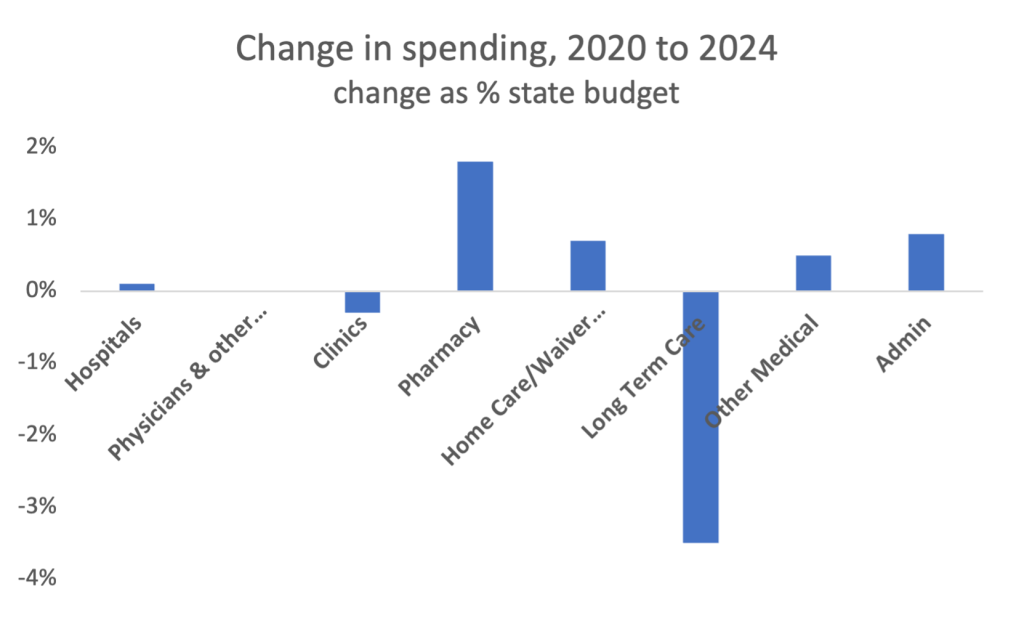
However, healthcare costs are still rising, even in Connecticut’s efficient program. As in other states, spending on pharmaceuticals is the main driver of rising Connecticut Medicaid costs since 2020, due to high-cost specialty drugs. However, Connecticut’s increases are below most states. Long Term Care spending, including nursing homes, dropped sharply from 2020 to 2021, largely due to COVID. Home care/waiver services and administrative costs are up.
Per member spending in Connecticut’s Medicaid program dropped significantly from 2013 though 2015, after switching from private Managed Care Organizations (MCOs) running the program. However, per member spending resumed a slow increase through 2020. When COVID hit, health care spending dropped sharply, as it did across the US. But per member spending has increased since then, as it has for the rest of the US.
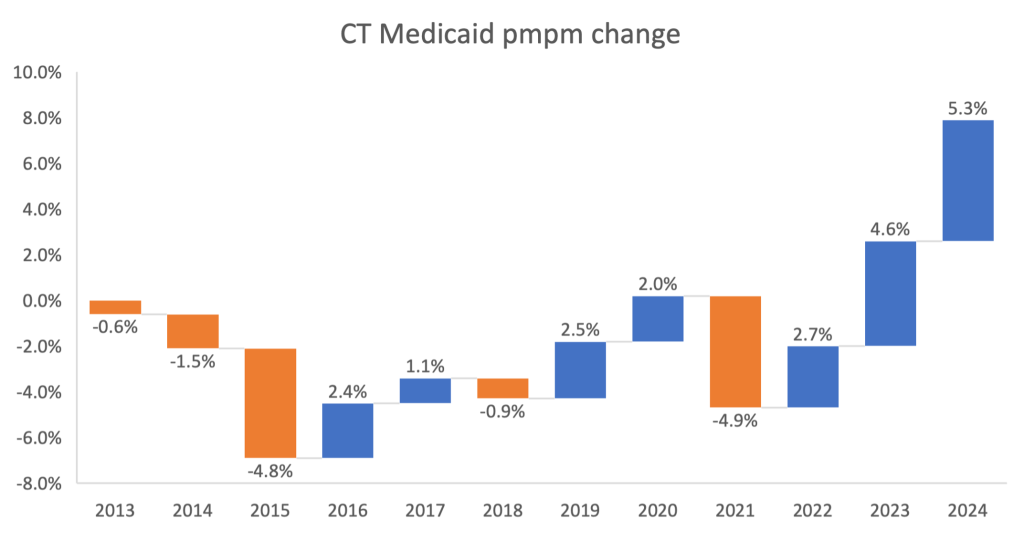
Per member costs rose 9.6% in almost two years from September 2022 to June 2024. This is faster than medical inflation across the US economy which grew 3.3% for the year ending June 2024 and 0.1% for the year ending June 2023. Since 2022, enrollment has fallen as COVID enrollment protections lapsed. However, it remains above pre-COVID levels. (Not pictured in the graphic below.)

Our state consistently spends less of our state budget on Medicaid than other states. Last year, Medicaid comprised 23.6% of Connecticut’s state budget compared to the 29.8% average for all states.

With an administrative burden of 2.6%, Connecticut Medicaid is very efficient. Connecticut Medicaid spends far less on administration than do most states, likely because we don’t use MCOs to run our program.

CT Medicaid’s administrative spending (2.6%) was four times lower than commercial insurers in our state (11.4% median) in 2024.

As in Connecticut’s population overall, costs for seniors and people with disabilities in Medicaid is higher than for families and childless adults. In 2024, just 9% of Medicaid members were seniors and people with disabilities, but their medical costs were 38% of the total. In contrast, children and parents were 56% of members but cost just 29% of the budget. Childless adults were both one in three members and used one third of the resources.

Medicaid provides important economic benefits beyond healthcare. There is evidence that Medicaid coverage protects people from medical debt, allowing families to invest in education, homes, and children’s futures. Medicaid improves the health of children and workers, benefitting Connecticut’s future and economy. Because Medicaid members can access preventive care, the program reduces more costly care later, uncompensated care costs to providers, and lowers healthcare costs for all of us. Ensuring that people can see a provider when they feel ill prevents serious public health threats from spreading.
Where does Medicaid’s money go?
As in other states, spending on pharmaceuticals is the main driver of rising Medicaid costs, likely due to high-cost specialty drugs. However, Connecticut’s increases are below most states’ trends. Long Term Care spending, including nursing homes, dropped sharply from 2020 to 2021, largely due to COVID. Home care/waiver services and administrative costs are up.
Since 2022, enrollment has fallen as COVID enrollment protections lapsed. However, it remains above pre-COVID levels. Per member costs rose 9.6% in almost two years from September 2022 to June 2024. This is faster than medical inflation across the US economy which grew 3.3% for the year ending June 2024 and 0.1% for the year ending June 2023.
As in the past, hospitals are the largest category of Medicaid spending, followed by Long Term Care, Home Care/Waiver Services, and pharmacy spending.

While comprising 12% of total Medicaid spending, pharmacy costs have been the main driver of rising Medicaid spending since 2020, likely due to high-cost specialty drugs. This is a national trend and Connecticut is doing better than most states in controlling drug spending.
Long term care costs are down sharply since COVID. Home care/waiver services and administrative costs are up.
Since at least 2017, the largest share of Medicaid spending has been on hospital services, both inpatient and outpatient care. Since 2021, that spending has moderated slightly as a percent of the total. Long Term Care spending dropped sharply from 2020 to 2021, largely due to COVID.

The federal share of Connecticut Medicaid spending rose to 68% in 2022, up from 55% in 2014. Variations were due to the stepped reduction in the ACA expansion population match rate under the Affordable Care Act and the COVID match increase in 2020.

How is Connecticut’s Medicaid program structured?
Connecticut’s HUSKY program is structured in four parts. Parts A, C, and D are under Medicaid and are entitlement programs. This means if someone qualifies for the program, the state must provide coverage. Eligibility for the Parts depends on income, disability status, pregnancy, and age.
HUSKY Part A includes pregnant women, children, and their parents or caregivers. Part C covers seniors and people with disabilities. Eligibility income levels are lower than HUSKY Parts A or C and includes an asset limit as well. Part D covers childless adults. Part D was added to program in 2014 when Connecticut was the first state to exercise our state option to expand Medicaid under the ACA.
HUSKY Part B is Connecticut’s Children’s Health Insurance Program (CHIP). Unlike Medicaid, federal funds for CHIP programs like HUSKY B are limited. If costs go over the federal limit, states must pay the full costs of coverage for recipients. Since 1997, when CHIP passed into law, Connecticut has never exceeded our federal funds limit. Also, unlike Medicaid, HUSKY Part B families must pay part of the costs of medical services, and some pay monthly premiums.

Who is covered by Connecticut’s Medicaid program?
In 2024, Connecticut Medicaid covered 1,073,458 people or one in three state residents. Enrollment grew substantially when the state expanded Medicaid under the Affordable Care Act, and again during the COVID pandemic. During the pandemic many people became eligible when they lost their jobs and their incomes dropped and the federal government increased Medicaid funding levels to states with the condition that states not remove anyone from the program until the pandemic was over. The Department of Social Services reassessed Medicaid recipients’ eligibility in 2023, and the numbers declined by 7.4%.

There are slightly more females in Connecticut Medicaid than males (53%, 47% respectively). Adults under age 65 make up almost two in three Medicaid members (60%), while children are one in three (33%) and seniors are a much smaller proportion (6.5%).

While most Medicaid members are white, Connecticut Black and Hispanic residents are more likely to be covered in the program.

How much does CT Medicaid pay healthcare providers?
Almost all providers (97%) participating in Connecticut Medicaid were satisfied with the administration of the HUSKY program in 2023. Unlike most states, Connecticut Medicaid pays providers a fee for each service they provide. Because our state program doesn’t use private insurance middlemen, or managed care organizations (MCOs), providers are paid directly by the state, eliminating administrative barriers. Providers can also earn more for providing patient-centered care coordination as a certified patient-centered medical home.
A new analysis finds that Connecticut Medicaid payment rates averaged 71% of Medicare rates for the same 33 codes for common healthcare services in 2024, slowly narrowing the gap since 2019. The national average was the same at 71%.

The report’s authors found that comparison states’ Medicaid rates were not as generous as Connecticut’s (71%) in 2024. Medicaid to Medicare rates for New York (69%), Massachusetts (68%), Rhode Island (57%), and New Jersey (55%) were all lower.
A comparison of 2024 state Medicaid rates by KFF, based on an analysis by the Urban Institute, found that Connecticut’s rates across all services average 79% of Medicare rates in our state, above the national average of 75%.
In 2024 and 2025, DSS commissioned a detailed analysis of the adequacy of Connecticut Medicaid payment rates across service areas. The two phase report (Part 1, Part 2) found that many Connecticut Medicaid providers are paid less than similar state Medicaid programs or Medicare rates. The generosity of Connecticut’s rates varied significantly between services and providers. According to the report, bringing all providers up to comparable rates would cost $300 million.
While Medicaid rates, for Connecticut and all states, are below Medicare and private health insurance rates, there is a persistent myth that increasing Medicaid rates will reduce insurance payment rates. In fact, there is no correlation between commercial hospital prices and the share of patients covered by Medicaid (or Medicare). In fact, hospital markets with slow Medicare rate growth also have slower growth in private plan payment rates. Like most industries, hospitals and health systems charge each payer based on their market power. Hospitals that are monopolies in their area can charge all payers more than those in competitive markets.
A provision of the Affordable Care Act temporarily increased primary care physician payment rates to equal Medicare. There is some evidence nationally that the fee bump increased access to care for members, and more providers accepted Medicaid patients. Connecticut was one of a few states that continued that rate increase, in full or in part, after federal funding ended.
Community health centers (CHCs) are paid differently than other Medicaid providers and, generally, at substantially higher rates for the same services. Medicaid base rates for a medical visit at a CHC are seven times the rate paid to other Medicaid providers for a doctor’s visit. CHC rates are also more than double Medicare’s rate and 87% higher than private insurance payment rates in Connecticut. PCMH Plus subsidies to CHCs are in addition to these rates and other grants.

Sources: DSS Provider Rate Fee Schedule, code 99212 (adult, established patient, 10 to 19 minute visit with physician, median); Medicare payment rate code 99212, TheraThink, FQHC Medicaid Rates, DSS (medical visit, median); Cost of private CT returning patient, office or urgent care, Sidecar Health, all accessed 1/28/2025
Ending managed care and implementing PCMHs
In response to extreme cost increases and poor quality performance, in 2012 Connecticut Medicaid ended their contracts with private managed care organizations (MCOs) that were paid a flat rate per member to provide care. The program moved to self-insurance by the state; now the state pays providers directly for the services they provide to Medicaid patients. The program is operated through an Administrative Services Organization, Community Health Network of Connecticut, with a focus on care coordination. In 2024, the Governor considered returning to the MCO model. But based on evidence on the benefits of the current system and strong political resistance, the state decided against MCOs’ return in 2025.
In 2012, simultaneously with removing MCOs from the program, the state began paying certified patient-centered medical home (PCMH) practices higher rates to coordinate patients’ care. PCMHs provide extended hours, coordinate care among providers for patients, make appointments with specialists, and follow up after ED visits and hospital admissions. PCMHs enable teams of different providers, all working at the top of their license, to provide comprehensive care to patients. To receive the extra payments, PCMHs must be certified by an independent, national certification body using evidence-based standards. PCMHs track the health of their entire patient population, anticipating and meeting their medical and social needs. PCMHs then offer extra services based on those identified needs, such as nutritional counselling and behavioral healthcare.
PCMHs have a well-documented record of improving access to high quality care, improving both patient and provider satisfaction, preventing health problems, and reducing overall healthcare costs. HUSKY’s PCMH program has continued to expand and improve care for patients ever since 2012.
In early 2024, the Governor considered returning to MCOs. Advocates and legislative leaders did not support that idea.
A great deal of evidence was collected finding that:
- There is no evidence that MCOs save money for states
- The evidence does not support MCOs improving either access to healthcare services or the quality of care
- Connecticut’s program leads the nation in cost control and the quality of care in Connecticut Medicaid is much better across dozens of measures than most states, which have MCOs
A consultants’ report in early 2025, commissioned by the Governor’s office, agreed that the program is strong, performing better in cost control, quality, and access to care than comparison states. They found that, “Overall, the Medicaid program achieves good quality compared with national benchmarks, spends significantly less per member than other Northeastern states and national average, cost growth below medical inflation, and much less on administrative costs than states that primarily use a managed care delivery system.” They did not recommend returning to an MCO model to run the program. The state agreed and abandoned plans to contract with MCOs.
How does care work for people on both Medicare and Medicaid?
In 2025, just over one in six (67,149) Connecticut Medicare enrollees have household incomes that also qualify for Medicaid, termed Medicare-Medicaid enrollees or dual eligibles. Connecticut’s rate, at 17% of total Medicaid enrollment, was the sixth highest among states. In 2021, care for dual eligibles accounted for 35% of Connecticut Medicaid’s total budget, higher than the US average of 29%.
Medicaid pays some or all of the Medicare premiums and cost sharing for dually eligible members, depending on income. For lower income members, Connecticut covers all Medicaid services and costs not covered by Medicare, including dental, vision, home and community-based services, and mental health. Total costs of care are considerably higher for dual eligibles than for other enrollees. In 2021 nationally, Medicare spent $312 billion on dually eligible enrollees’ care while state Medicaid programs spent $181.5 billion. Higher costs for duals are driven by long-term services and supports spending, including institutional and home-based care.
How will the new federal budget bill affect Connecticut Medicaid?
The 870-page One Big Beautiful Bill Act (OBBBA) signed into law by President Trump on July 4, 2025 will have serious implications for Connecticut residents across many areas. But the bill’s cuts to Medicaid will be significant, harmful, and broad. The OBBA and the implementing regulations to come, will affect Medicaid coverage and access to care, cut funding to the state, impose new costs for some members, and dramatically expand state agency administrative burdens. The details and effective dates of the impacts will vary as the law is implemented.
In total, it is expected that roughly 150,000 more Connecticut residents (110,000 to 190,000) will become uninsured due to the OBBBA, increasing our uninsured rate by 4%.
Healthcare coverage saves money, lives, and benefits communities. There is strong evidence that coverage expansions under the Affordable Care Act both saved money and reduced deaths. Rising costs of care for the uninsured will hit healthcare providers, communities, and raise public health risks for all of us. Care for people who couldn’t pay their bills cost Connecticut hospitals $250 million in 2023; this could double with the OBBBA. Providers who don’t get paid will have to raise prices for the rest of us – and we can’t afford that. Studies link rising healthcare prices to higher unemployment, lower wages for people who still have jobs, and reduced tax revenue.
The main changes in the OBBBA relevant to Connecticut’s Medicaid program are:
- Requirement that many adult members work for pay, volunteer at community organizations, or are in school at least 80 hours per month
- There are a few categories of exemptions from the work requirement including people with disabilities, caretakers of a patient with serious health needs or a child under age 13,This has been very difficult to administer in other states and many people who were working lost coverage due to red tapeIt is estimated that 74,000 to 85,000 Connecticut Medicaid members will lose coverage just due to the work requirement
- Most of the Medicaid members losing coverage are in HUSKY Part D, Connecticut’s Affordable Care Act (ACA) expansion population. Research finds that the ACA expansion of coverage reduced mortality/deaths by 21% among the newly covered.
- For HUSKY Part D members who can remain in the program there will be more administrative red tape and new copays of up to $35 each time they receive many healthcare services.
- Reductions in an important state option that is used to increase provider payment rates
- No federal funds to cover healthcare from Planned Parenthood, including primary care and other non-abortion services
- Many immigrants legally residing in the country will be prohibited from Medicaid
- Shorter look-back period to cover recent healthcare costs when people join the program
- It is expected that Connecticut will lose between $8 billion and $14 billion in federal funding for Medicaid over the next ten years.
- The state may be able to cover the costs of some or all of these cuts, but the consequences and sacrifices in other areas are unclear
- Medicaid administrative costs will increase dramatically
- Under the OBBBA, health insurance subsidies through Access Health CT will be allowed to expire at the end of 2025 resulting in higher costs to the state and/or more state residents losing coverage
- The OBBBA will significantly increase premiums for people in AccessHealthCT who keep their insurance, more red tape for people applying for coverage, and less time to decide on a plan they can afford.
- AccessHealthCT estimates the loss of health insurance subsidies will cause 52,500 Connecticut residents to become uninsured
Trends
- The future of Connecticut’s Medicaid program is very uncertain since passage of the 2025 federal budget law.
- State policymakers have expressed their commitment to mitigate the damage as much as possible.
- For now, Connecticut will not return to private insurers to run our Medicaid program.
Updated July 30, 2025