Health Equity Basics
Health outcomes are not equal across Connecticut populations. State residents of color, women, people who identify as LGBTQ+, and people with disabilities have greater challenges remaining healthy. Researchers estimate that only 16% of health outcomes are related to clinical care, while socioeconomic factors and health behaviors are the majority contributors. Social determinants of health such as economic stability, food security, safe housing, and education have an enormous role. Unfortunately, Connecticut’s healthcare workforce is not as diverse as the state population. But there are evidence-based solutions to address disparities and improve the health of every Connecticut resident.
Health Equity Deeper Dive
What is Health Equity?
In simple terms, health equity is giving every individual the opportunity to be as healthy as possible, regardless of race, ethnicity, gender, sexual orientation, or disability status. However, this should not be confused with equality. It’s critical to recognize the unique needs or resources a person or group of people need to thrive. Health equity is not simply offering all individuals the same opportunities but working to eliminate the disparities within a population to allow everyone to be as healthy as possible.
Health disparities touch every Connecticut city and town. Some groups most vulnerable to inequities are people of color, women, people who identify as LBGTQ+, and those living with disabilities. Connecticut is not immune to disparities. While disparities are harmful to individual and community health, they are also costly. A state study estimated that disparities cause an extra $384 million in hospital costs for Black state residents and another $121 million for Connecticut Hispanics.
Connecticut’s State Health Improvement Plan (SHIP) called Healthy Connecticut 2025, is focused on improving equity and eliminating structural racism. The plan is built on four Social Drivers of Health. The goals, objectives, and strategies are listed below.

Race and ethnicity
Connecticut is not immune to significant racial and ethnic health disparities including higher rates of asthma, diabetes, cancer, infant mortality, and uninsurance.

In 2019, Connecticut’s Black infant mortality rate was nearly two and a half times greater than for whites. Black women in Connecticut have less access to optimal prenatal care and higher rates of uncontrolled chronic diseases putting both Black mothers and infants at risk of higher rates of mortality.
In 2020, Black Connecticut residents were more than twice as likely to die from diabetes than whites. Also in 2020, Black residents were three times more likely to undergo a diabetes-related lower-extremity-amputation than whites, which is usually preventable with adequate medical care. Among Hispanics, the rate of enduring a diabetes-related lower-extremity-amputation was just over two times greater than whites in Connecticut.
Hispanic children and teens in Connecticut are four and a half times more likely than whites to visit an emergency room for asthma, and over three times more likely to be hospitalized. Hispanic and Black state residents are twice as likely to have diabetes and more likely to have serious complications of the disease.
The burden of disparities doesn’t fall only on Connecticut residents of color. It’s estimated that disparities cause an extra $384 million in hospital costs for Black state residents and another $121 million for Connecticut Hispanics. We all pay these costs in higher health prices, insurance premiums, and taxes. Experts estimate that inequity currently costs the US health system $320 billion each year. Those costs are growing and could reach $1 trillion annually by 2040.

LGBTQ+
Lesbian, gay, bisexual, and transgender Americans have a long history of unmet health needs. The Affordable Care Act and the Supreme Court decision on marriage equality improved access to care, but there are still significant gaps.
A 2022 community needs assessment of Connecticut’s LGBTQ+ community for the Department of Public Health found that sixteen percent of survey respondents reported being refused healthcare services because of their LGBTQ+ identity. Two thirds had concerns about accessing healthcare, including that care would not be LGBTQ+ friendly, providers and staff would not be trained in their needs, and not knowing where to access services. Challenges noted in the survey included being misgendered or “deadnamed,” harassed, or unnecessarily questioned by providers who lacked an understanding of LGBTQ+-related health needs, and stigma surrounding STD/STI-related healthcare.
Disabilities
People with disabilities are less likely to get primary, preventive and maintenance care, with costly consequences. In Connecticut, one in four adults, or 26% of Connecticut’s population has a disability. People with disabilities face high rates of health inequities. Connecticut residents with one or more disabilities are over three times more likely to have depression and more than twice as likely to have heart disease and diabetes when compared to Connecticut residents without a disability.
About 45,000 Connecticut residents have developmental disabilities. Adults with intellectual and developmental disabilities are five times more likely to be in poor health, half as likely to get a check-up, have lower rates of blood pressure checks, flu shots, oral healthcare, and screens for cancer, cholesterol, vision or hearing screens than people without disabilities. Women, especially pregnant women, with disabilities face special barriers to care.
Compared to Americans without disabilities, adults with intellectual and developmental disabilities are five times more likely to be in poor health and half as likely to get a check-up. They have lower rates of blood pressure checks, flu shots, and screens for cancer, cholesterol, vision, or hearing health. They are also four times less likely to get enough physical activity and more likely to be obese.
Studies have found resistance among physicians to caring for patients with developmental disabilities. Researchers found structural and financial barriers, as well as poor information and biases, that affected their willingness to care for patients with disabilities. Physicians are overwhelmed, both in general and by legal requirements. They often lack knowledge and feel unqualified to care for patients with disabilities. One noted that the usual fifteen-minute visit is “absolutely ridiculous”. People with disabilities are more likely to report inadequate patient-physician communication that affects their access to care and health outcomes.
Gender
In 2021, women in Connecticut were more likely to be in poor physical and mental health than men (10.1% vs. 7.6%, and 15.2% vs. 10.2%, respectively). In 2019, women in Connecticut had the fourth highest rate of breast cancer among states.
A significant inequity that directly affects health is the gender wage gap. Women in Connecticut earn 84 cents for every dollar paid to men. Even more sobering, Latina and Black women in Connecticut make only 47 and 58 cents for every dollar paid to men, respectively. Because they earn less, women often face more difficulty paying for healthcare bills, prescriptions, and health products, creating a health inequity.
What can cause health inequities?
While there is not a single answer, social determinants of health are an important factor.
Social determinants of health (SDoHs) are the conditions in the environments where people live, work, play, learn, and age that affect health outcomes. SDOHs reveal the interrelated aspects of health inequities that lead to poor health outcomes. Recognizing and working to improve SDOHs are very important because an individual’s overall health is determined far more by their social determinants than the medical care they receive. Researchers estimate that medical care contributes 16% to our health outcomes while socioeconomic factors contribute 47%, health behaviors 34%, and the physical environment just 3%.
What are Social Determinants of Health?
Social determinants of health span a wide continuum of overlapping factors, including economic stability, food security, housing, and education.
Economic stability/Poverty
People with financial security/steady employment are more likely to be healthy and less likely to live in poverty. Those who are financially insecure, particularly those in poverty, are much more likely to suffer from food and housing insecurities which lead to higher incidences of diabetes, cancer, and poor birth outcomes.
Employment alone is not enough to protect health. Underemployed, involuntary part-time workers are more likely to suffer from both medical and mental health problems due to higher work stress, work-life imbalance, and financial insecurity.
Moreover, people with low incomes suffer from higher rates of depression which is associated with further negative health outcomes such as greater disease burden, longer duration of illness, disability, and suicide. Without economic stability, people often struggle to afford health care, afford transportation to access health care, cannot take time off work to receive care, cannot afford healthy or nutritious foods, lack resources to safely exercise, and cannot afford to live in a healthy environment.
In 2019 in Connecticut, the white poverty rate was 5.8% while the Black and Hispanic poverty rates were 18.4% and 22%, respectively. Economic instability directly impacts health equity and overall health outcomes.
Too often, the structure of healthcare coverage plans relied on by low-income Americans increase disparities. A study found that unlike low-income white families, average savings levels for low-income black and Hispanic families with high deductible health plans were well below their deductibles. Even modest health problems could decimate family finances. Another study found that Medicare value-based payment reforms, meant to improve access to better quality care, widened disparities for three common conditions.
Food Insecurity
Food insecurity is another SDOH described as an individual being unable to afford food at least once in the last 12 months. Good nutrition is critical for the body to dedicate energy to healing from an illness, managing chronic diseases, strengthening the body’s immune responses, and overall health. Unsurprisingly, Connecticut residents with lower incomes suffer worse food insecurities. For households with very low incomes, the Supplemental Nutrition Assistance Program (SNAP) helps to cover some costs of food with subsidies estimated to be $1.86 per meal. Unfortunately, in Connecticut, the estimated cost of a meal is 40 to 50% higher than the SNAP per-meal benefit.
In Connecticut, 23% of Black adults and 28% of Latino adults experienced food insecurities, compared to just 10% of white adults. Consequently, Black and Latino adults in Connecticut are more likely to have poor nutrition and lack access to nutritious foods, further impacting health outcomes.
Housing and the Physical Environment
Another SDOH with profound impact on overall health is the home and physical environment. Barriers to affordable and safe housing can negatively affect health by exposing individuals to harmful environmental conditions in the home or neighborhood and limiting available resources that can be used for food, healthcare, or education. When families or individuals have to spend a large part of their income on housing (more than 30%), this can exacerbate stress levels and mental health illnesses and is linked to an increased risk of disease because there isn’t money for healthy foods or healthcare.
In Connecticut, 34.6% of residents report spending more than 30% of their income on housing. Among Connecticut residents, 44.5% of Black residents, 45% of Hispanic or Latino residents, and only 32.6% of white residents reported spending more than 30% of their income on housing.
Women in Connecticut experience a much greater cost burden for housing when compared to men. For example, 50% of white women who rent experience housing cost burdens, compared to only 39% of white men who rent housing in Connecticut. Moreover, 62% of Black women and 63% of Latino women who rent housing experience housing cost burdens compared to only 50% and 52% of Black and Latino men, respectively.
Additionally, the physical environment is also a social determinant of health impacting health outcomes. Connecticut children who live in urban areas experience a six times greater rate of lead poisoning (4.9%) than children living in suburban communities (0.8%). Lead poisoning in early childhood, when rapid neurological development takes place, is dangerous to growing children with profound effects on their health. Access to neighborhood amenities such as parks, bike trails, gyms, and recreational facilities is associated with improved physical and mental health, as well as a sense of belonging. In Connecticut, residents in rural locations were less likely to have access to these resources, while white adults, residents of suburban or wealthy towns, and adults with higher levels of income and education were more likely to report access to these resources.
Education Access and Quality
People with higher levels of education are likely to live longer and be healthier. Children from low-income families or who have disabilities are more likely to struggle with math and reading and are less likely to graduate from high school or go to college. These problems can lead to difficulty obtaining safe and stable employment with health benefits, and to developing health problems such as heart disease, diabetes, and depression. Additionally, children who live in poverty often attend poorer-performing schools, and many families in poverty cannot afford to send their children to college. Children who live in poverty experience stress that can affect brain development, making it even more difficult for them to perform well in school.
In Connecticut, children with Special Education (SPED) or English Language Learner (ELL) designations have much lower four-year high school graduation rates. Children with SPED designations have a graduation rate of 67% while 92% of non-SPED students are able to graduate. Similarly, Connecticut ELL students graduate at a rate of 68%, while 89% of non-ELL students graduate.
Is Connecticut’s healthcare workforce diverse?
There is ample evidence that diversity among healthcare providers supports improving access to care for underserved populations. Unfortunately, Connecticut’s healthcare workforce does not reflect Connecticut’s population in race and ethnicity. Whites are over-represented while Blacks and Hispanics are under-represented among Physicians, Advanced Practice Nurses, Physician Assistants, Registered Nurses, and Dentists.


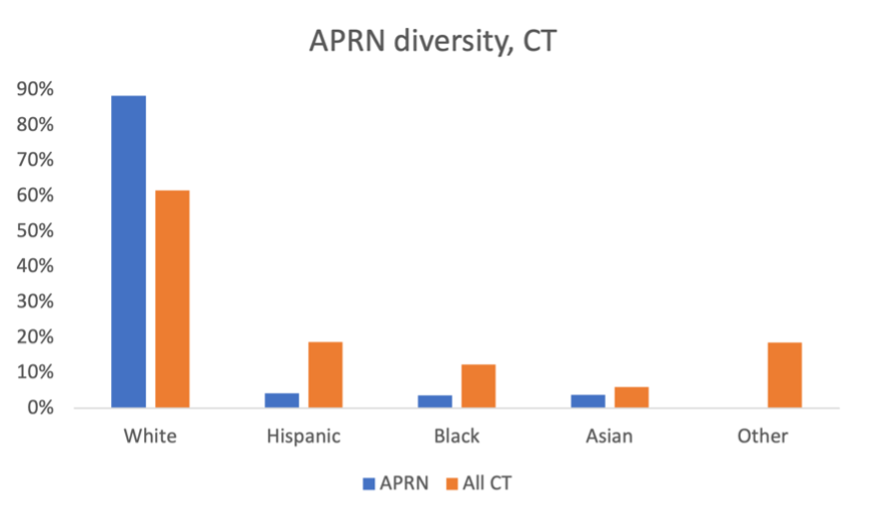


Source: Area Health Resources Files, HRSA
Researchers have identified policy and practice solutions that can help diversify the workforce. Recommendations cross educational, career, financial, social, and institutional supports.
How can healthcare planning promote equity?
Disparities can be unintentionally embedded in policymaking. Connecticut is making progress, but more is needed. Without conscious and vigorous effort to address biases, those disparities will continue into the future.
The Connecticut Health Foundation has developed recommendations for policymakers to promote Better Health for All, including underserved communities. The recommendations include expanding coverage, care coordination to promote prevention and manage chronic health problems, engage Community Health Workers in their communities to improve health, and ensure all eligible state residents enroll in Medicaid.
Medical algorithms, powered by Artificial Intelligence (AI), are powerful tools to help standardize medical decision-making, which should make healthcare decisions more fair. But there are problems when the tools are based on biased rules and homogeneous datasets. For example, different standards for Black patients in determining kidney function put them at a disadvantage in getting a transplant, and racial corrections in lung function tests led to missed diagnoses of serious pulmonary disease. It has been very difficult for well-meaning scientists to get the tools right. An excellent series of investigative reports by STAT news, Embedded Bias, explores the promise and the reality of race-based healthcare decision-making tools.
There is a special concern that, as more payers use health technology assessments (HTAs) to promote value in the healthcare system, that health equity be incorporated into the methods to ensure underserved communities have fair access to innovative new treatments. HTAs are evidence-based evaluations of healthcare treatments for clinical effectiveness and fair pricing. HTAs ensure the system rewards innovations that significantly improve health with fair prices.
Consulting with experts and patient advocates, the Institute for Clinical and Economic Review (ICER) has developed standards for entities assessing clinical effectiveness and fair pricing, in the US and beyond, to promote health equity. The standards were developed in consultation with providers, patient advocates for underserved communities, bioscience, insurer, and academic sources. ICER is the US leader in assessing healthcare treatments for value. ICER’s reports are used by most government and private payers in developing coverage policies and fair prices.
The standards include:
- selecting treatments for study
- engaging patients in the process
- evaluating the diversity of clinical trial participants
- analyzing the data by subpopulations
- measuring opportunities to reduce disparities
- promoting equity through quantitative comparative effectiveness analysis, and
- promoting equity through deliberative methods
Solutions for social determinants of health

While there is much to learn, there are policy options that can improve equity. Proven public health interventions are key. There is a great deal of research identifying public health interventions that are proven to reduce inequities, improve health, and lower total healthcare costs. Among the most effective are tobacco control, food safety, reducing infections in healthcare settings, motor vehicle injuries, teen pregnancy, and improving nutrition, physical activity, and lowering obesity rates. Searchable databases have made it easy to prioritize initiatives and identify best practices. There is help for state policymakers in using that research to implement proven interventions.
There is good evidence that including support professionals in care teams improve health outcomes and patient experience of care, especially for underserved populations. Sustainable funding for community health workers and other health support professionals could reduce health disparities by creating relationships that improve health. They have shared experience with the populations they serve. A report by the CT Health Foundation offers policy options to support these professions and build capacity.
A White House Playbook to Address Social Determinants of Health includes specific actions to improve health across populations. Recommendations include expanding data gathering and sharing, flexible funding for social needs, and support for backbone organizations – e.g. housing, social services care, nutrition assistance, employment training, and economic development through community-based partnerships.
Connecticut’s Department of Public Health has also created a Health Equity Toolkit for local public health departments and other partners with resources and practical tools to help understand health equity and include it in their work. Connecticut’s Medicaid/HUSKY program also has information and resources for providers including assessments and other tools to identify and address the drivers of inequity for their patients.
Conclusion:
Discrimination, even unintentional, and SDOHs have strong influences on health outcomes and directly impact health equity. To truly improve health outcomes and lessen health inequities, emphasis must be placed on rooting out discrimination and expanding SDOHs when considering each person in a given population. While there have been great strides taken to address both discrimination and SDOHs in Connecticut, there is still much work to be done.
Written by Haley Magnetta, PA-C, MPAS, DMSc, Stefanie Generao, APRN, DNP, and Ellen Andrews, PhD.
Updated February 13, 2025