Workforce Basics
More than one in eight Connecticut employees works in healthcare. It is one of the fastest growing employment sectors in the state, as demand for healthcare increases. In general, healthcare jobs are well-paid, but many require extensive education. Physicians are the highest paid workers in Connecticut and across the US. Violence against healthcare workers is a growing problem, pushing many out of the field. Community health workers are a relatively new provider category bridging underserved communities with clinical care. Connecticut’s healthcare workforce does not reflect Connecticut’s population in race or ethnicity. The state has identified shortages in several workforce categories driven by clinicians who are no longer practicing, a shortage of training slots, and both aging providers and aging state residents. The state has developed a strategic plan and devoted resources to addressing gaps in Connecticut’s healthcare workforce. Experts are skeptical that AI will reduce health professional shortages in either the long or short term.
Workforce Deeper Dive
How many healthcare workers does Connecticut have?

As of February 2026, one in 7.4 Connecticut workers is employed in healthcare. The healthcare job sector is the fastest growing in our state. It’s projected that between 2025 and 2027, healthcare will add more jobs than any other sector in Connecticut, accounting for 39% of the total increase in state employment. Between 2020 and 2030, total health diagnosing and treating practitioner employment is expected to grow 10.6%, and health technologists and technician employment are predicted to rise 6.6%. Also, between 2020 and 2030, nurse practitioners and physician assistants are expected to grow by 48% and 30%, respectively.
What types of clinicians work in Connecticut? How much do they make?
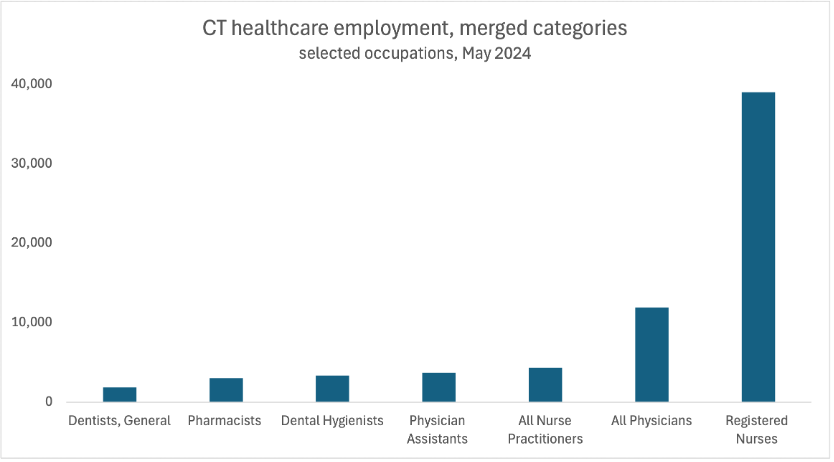
Registered nurses are by far the largest healthcare employment category in Connecticut at 39,020 in 2024, more than all the other categories combined. In 2024, Connecticut had almost as many Advanced Practice Nurse Practitioners plus Physician Assistants (8,050) as Physicians (8,580).
As for the entire US, Connecticut physicians make the highest wages in the state, comprising all top 10 categories.
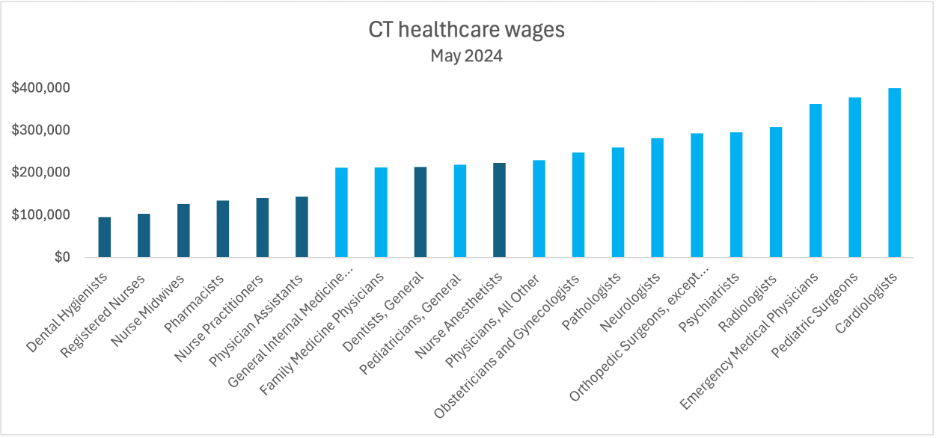
Source: Occupational Employment and Wage Statistics Query System, US Bureau of Labor Statistics, accessed 4/17/2025
Registered Nurses coordinate and provide patient care, educate patients and the public about health conditions. They can work in hospitals, doctor’s offices, nursing homes, outpatient clinics, schools, and home health agencies.
Nurses are educated in vocational programs at community colleges as well as four-year colleges and universities. Fifteen Connecticut schools offer a four-year Bachelor’s of Nursing degree, eight offer a two-year Associate Degree in Nursing, and two offer a master’s level program. To become registered as a nurse, applicants must pass the NCLEX exam and apply for registration with Connecticut’s Department of Public Health.
Physicians diagnose and treat health conditions and help patients manage their health issues. Physicians work in hospitals, outpatient clinics, and doctor’s offices.
Physicians first earn a bachelor’s degree, then attend a medical school for four years. Connecticut has three medical schools – Yale University School of Medicine, University of Connecticut School of Medicine, and the Netter School of Medicine at Quinnipiac University. After graduation, aspiring physicians complete a Medical Residency Program for three to nine years, depending on their specialty. Further training as a Fellow may be necessary for highly specialized fields. Physicians must pass exams from the US Medical Licensing Exams to practice before applying to Connecticut’s Department of Public Health for licenses.
Nurse Practitioners provide healthcare services and coordinate care. They practice in hospitals, outpatient clinics, and practices. Nurse practitioners start their education as nurses but also earn graduate level degrees in their specialty including midwifery, anesthesia, psychiatry, and family medicine.
Physician Assistants diagnose and provide care to patients under a physician’s supervision. Physician Assistants earn a master’s degree to qualify, after earning a bachelor’s degree. There are five Connecticut schools that offer Physician Assistant programs. Physician Assistants are certified by passing an exam and licensure by the Connecticut Department of Public Health.
All healthcare providers are licensed by Connecticut’s Department of Public Health. To look up your physician’s profile click here.
Are there shortages of some clinicians?
According to the Governor’s Workforce Strategic Plan, “Healthcare is consistently the most in-demand industry in every region of the state.”
Both the US and Connecticut are facing shortages in several healthcare professions. The US Health Resources and Services Administration has identified 177 Health Professional Shortage Areas across Connecticut. As Connecticut’s older adult population expands and rates of chronic and behavioral health conditions increase, healthcare workforce needs will grow.
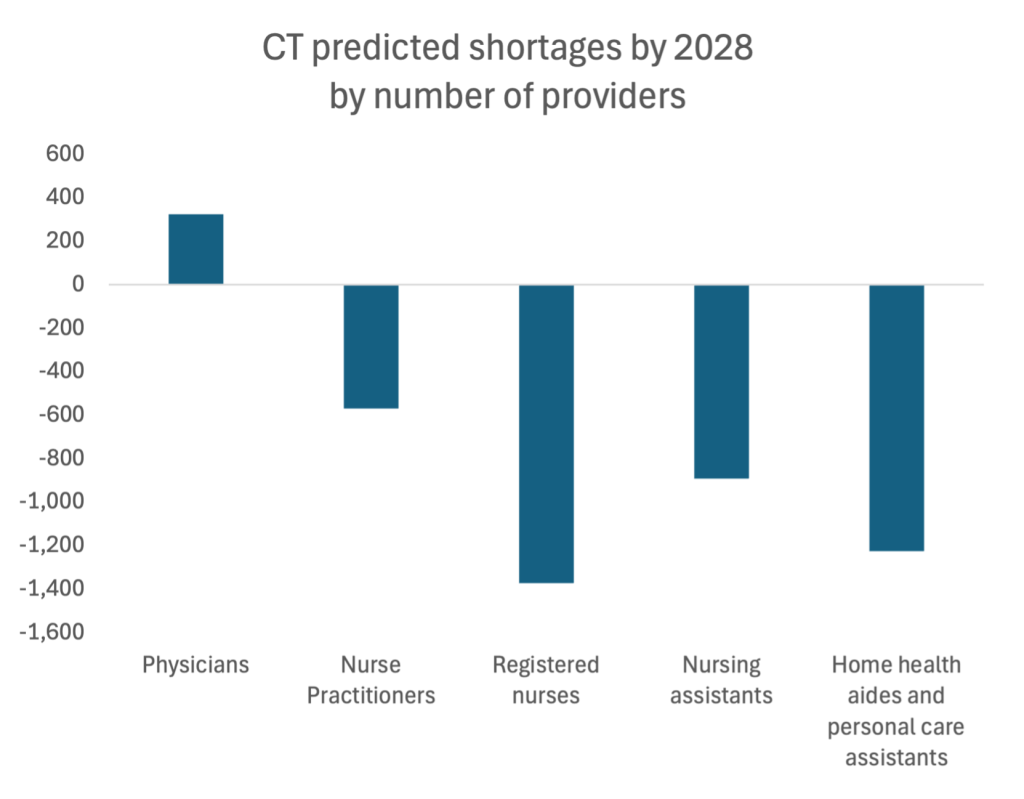
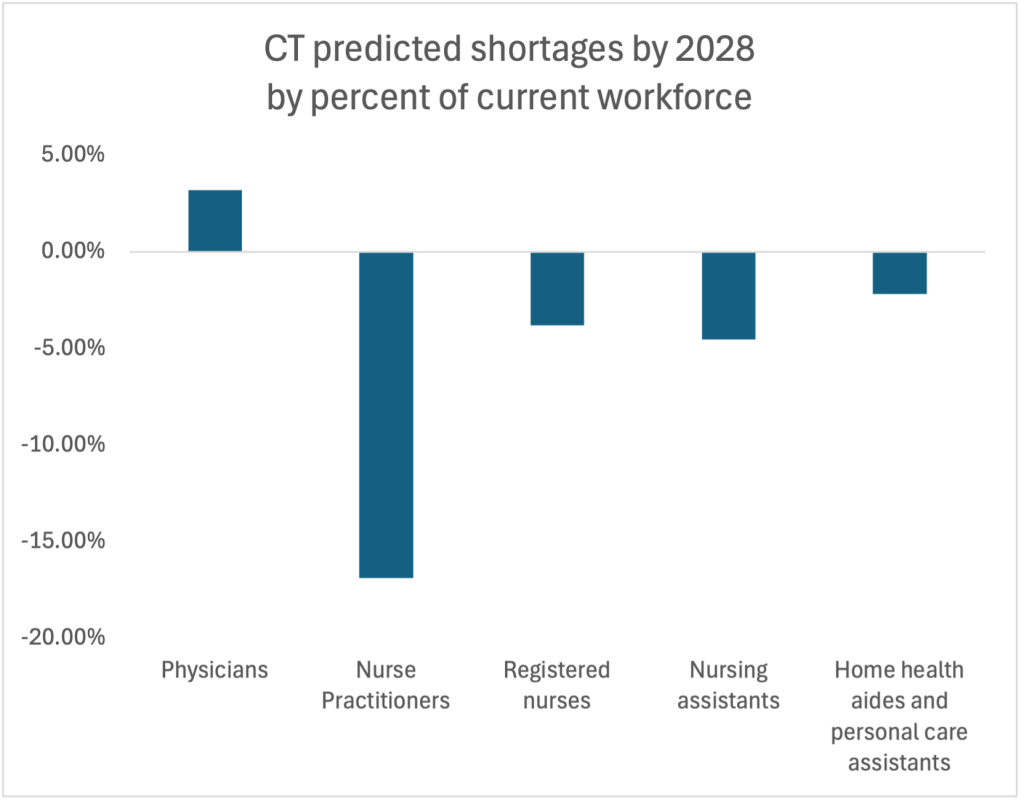
A 2024 report from Mercer estimates that across five critical categories Connecticut will need 5,700 (2.64%) more providers by 2028. They predict a shortage of nurse practitioners, registered nurses, and home health aides/personal care assistants. In good news, we are in better shape than most other states.
Immigrants play a vital role in the US healthcare workforce, especially for direct-care workers in long-term care settings. Three in ten US direct-care workers are immigrants.Direct-care work is very stressful and pay is low. Turnover is high in both home care and institutional settings.
Recent aggressive federal deportations of immigrants, including those legally here, are exacerbating healthcare shortages. The federal deportation of protected Haitian workers fleeing armed conflict is creating a significant shortage of nursing home staff in Connecticut. At least 100 certified nursing assistants, nurses, and housekeeping workers have been removed from state nursing homes as of July 28, 2026.
According to the CT Center for Nursing Workforce and the CT Data Collaborative, Connecticut schools are graduating more nurses every year. However, we haven’t caught up to the state’s needs.
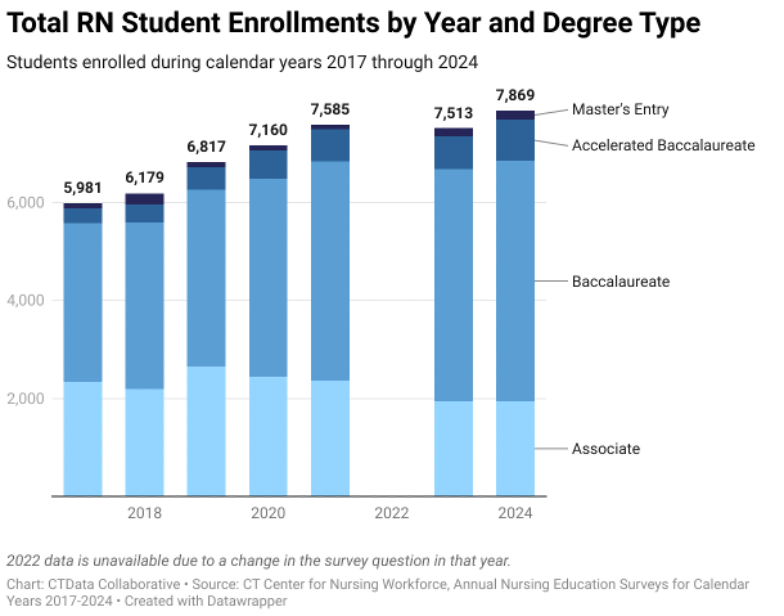
COVID accelerated the workforce crisis, but even before the pandemic Connecticut experienced acute shortages. Shortages are driven by several trends including providers who have left clinical practice, aging provider populations, and a shortage of training slots at colleges and universities.
An important contributor to the shortage of healthcare professionals is rising violence in the workplace. Violence against providers is commonplace, including in Connecticut. States are stepping up to protect healthcare professionals from violence, but more needs to be done.
A 2026 study found that between 2012 and 2024, there were 327 shootings causing 81 deaths at US hospitals in 47 states, including in Connecticut. Hospital staff are the most common victims. The rate of hospital shootings is growing, mirroring increased gun violence across the US.
In response to reports of violence against healthcare providers, Connecticut passed some measures to help protect workers. The state increased penalties for assault of a healthcare employee. Large healthcare institutions must convene safety committees, conduct a risk assessment, and develop violence prevention and response plans. They must also collect information on violent incidents and report them to law enforcement. The Department of Public Health has developed a media campaign about healthcare worker safety.
In 2022, the CT Data Collaborative found that just half of licensed registered nurses in Connecticut were actively working in nursing. That is up 5% from two years before.
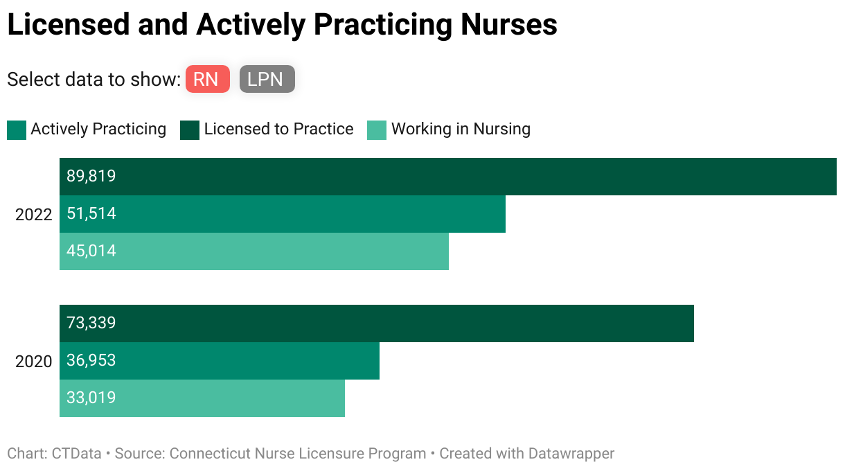
Many practicing providers are aging out of the workforce. It is unclear if new entrants will fill all the need.

Connecticut’s healthcare workforce does not reflect Connecticut’s population in race and ethnicity. Whites are over-represented while Blacks and Hispanics are under-represented among Physicians, Advanced Practice Nurses, Physician Assistants, Registered Nurses, and Dentists. (Data for 2015 through 2019, total population from 2020. Federal racial and ethnic data no longer available.)


Who are Community Health Workers?
Community Health Workers (CHWs) are a relatively new and critical category of health worker. CHWs bridge the gaps between medical care and public health. They are connected to communities and patients, helping them navigate the healthcare system. CHWs often come from the same communities as their patients and have lived-experience in navigating complex health problems. They can work in diverse settings and functions including support for newborns and moms, vaccination, linking patients to social services, and coordinating medical care. Certification of CHWs varies across the US. The CT Department of Public Health certifies CHWs in our state.
What is being done to address the workforce shortages?
In Connecticut, healthcare labor costs are up about 15% since COVID, staff turnover hovers between 18% and 30% annually, and nurse vacancies are up 30%. Connecticut hospitals are working with policymakers to create solutions for shortages of doctors, nurses, and healthcare workers. Through higher wages, improved benefits, and schedules that improve work-life balance, hospitals hope to recruit and retain vital staff. Partnerships between academic institutions and hospitals are increasing opportunities for clinical training, employment opportunities, and retention.
There is good evidence informing how to support healthcare providers to increase and retain workers. Strategies include dedicated healthcare workforce planning, identifying needs, improved working conditions, education and training, robust support systems, and testing proven interventions.
The Governor’s Workforce Council released a Strategic Plan in 2020 that called for adding 3,000 healthcare workers annually to meet the demand. In response, the legislature passed An Act Expanding Training Programs for Careers in Healthcare in 2022. They also appropriated $35 million over three years to recruit, educate, and employ nurses and social workers in Connecticut. In 2023, Connecticut passed Public Act 23-70 to develop a plan to address the need for clinical training placements and a student loan subsidy program. In 2024, the state passed PA 24-83 directing Connecticut to join the Nurse Licensure Compact allowing nurses licensed in the 43 cooperating states to practice across all those states.
Expanding providers areas of practice can help fill shortages. Increases in advanced practice nurses nationally are expected to help alleviate physician shortages. A new synthesis of the literature finds that nurses can deliver a great deal of hospital care traditionally provided by physicians with no difference in quality, patient safety, or patient satisfaction.
Artificial intelligence has been offered as a tool to increase the efficiency of clinicians, however experts are skeptical. A survey found that experts are uncertain whether AI will improve access to care in the short term when applied to specific clinical tasks. Experts are even more skeptical of long-term plans for licensing Al to prescribe medications.
Increasing adoption of technology tools and other innovations such as telemedicine, health information exchange, engaging Community Health Workers in care teams, and some artificial intelligence tools hold promise to improve both quality of patient care and assist providers.
The Affordable Care Act included some provisions to expand clinical capacity, but they weren’t fully implemented. With increasing shortages and the impact of COVID on providers and burnout, there are calls to develop a national healthcare workforce plan.
Updated July 30, 2026